
Boring technologies and why we love 'em
Web technologies develop quickly, and exciting ones often tempt us to ride the hype train.
However, if you are responsible for operating the software in production, you will quickly learn that the “exciting” choice is often the one you end up regretting when upgrades cause problems.
What we mean by “boring”
At codefortynine we love boring technologies instead of the bleeding edge. By boring we mean:
- Stable and mature: proven in real production environments, established user base
- Predictable in change: stable core features, LTS version
- Well-supported: bugs and vulnerabilities fixed, documentation and community available
These typically fall within the early or late majority of the adoption curve. In addition, minimalistic in-house solutions that meet needs without extras could fall in this category. Instead of boring, we could say reliable or foundational.
Why “boring” wins (most of the time)
While this may seem less exciting than using the latest technology, it offers several benefits. Mature long-lived technologies, refined through years of production use, offer more features, have established communities, and provide more complete tooling. In contrast, when technology is new or develops rapidly, breaking changes and unexpected bugs occur more often. Emerging projects may also get abandoned easily if they cannot gather a critical mass of users.
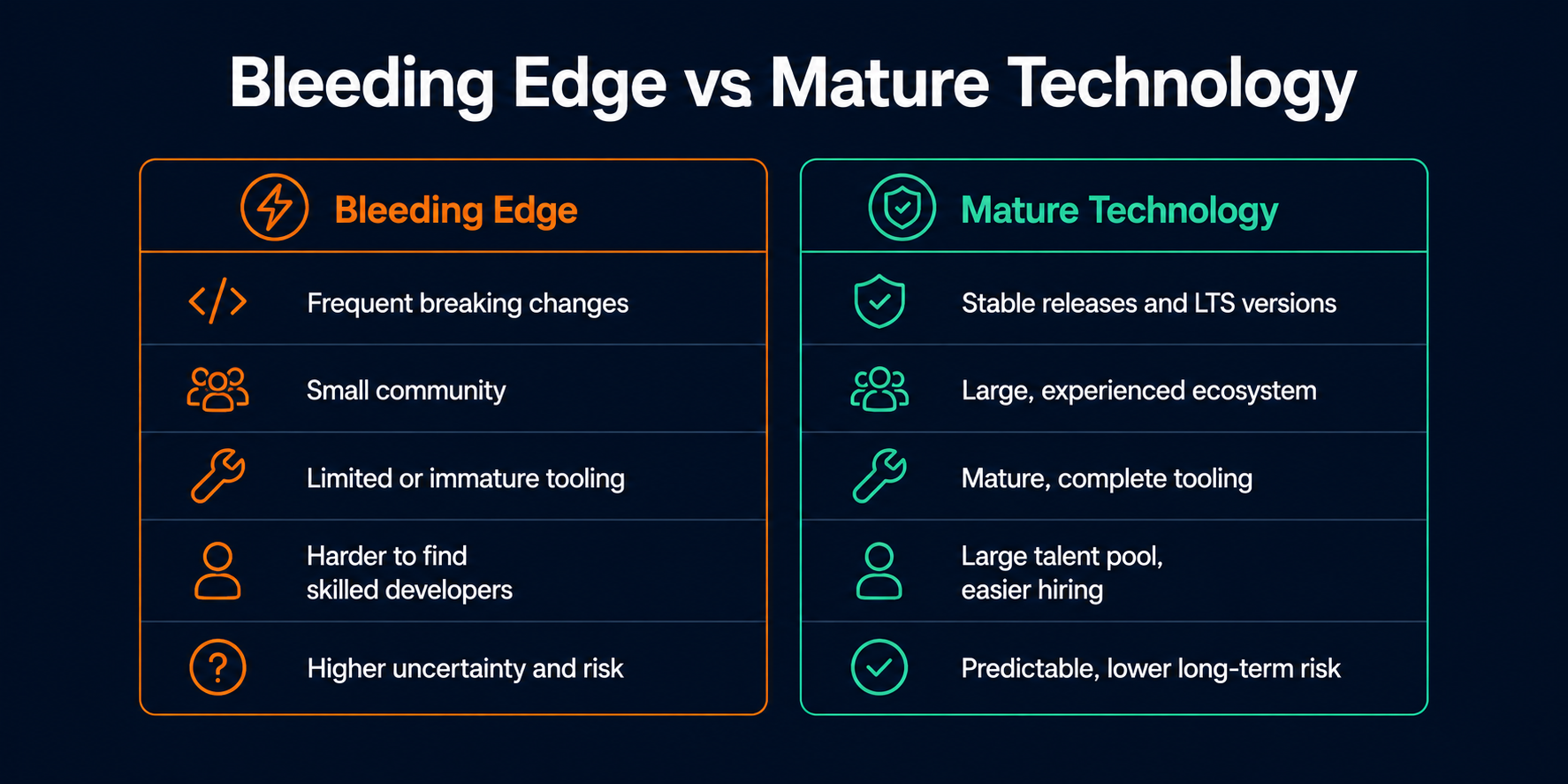
Established technologies have a larger pool of experienced developers, while finding developers skilled in emerging or niche technologies can be difficult. Dependency management is easier when choosing a suitable set of libraries and avoiding frequent new dependencies. Finally, although an established technology can have a steep learning curve, it likely has more documentation, tutorials, and experienced users.
The trade-offs and how “boring” can go wrong
Relying on long-lived technologies can also have downsides. Projects may be abandoned or outdated, but by “boring” we do not mean obsolete. Stable technologies have fewer breaking changes and bugs but can become rigid and hard to adapt to changing requirements, while new tools add features faster. When using libraries with different development paces together, version conflicts can occur. Overusing in-house solutions wastes effort if good tools already exist.
How we choose at codefortynine
At codefortynine, we focus on pragmatic technologies rather than following hype. We use stable solutions that fit our use cases and build our own when needed.
This philosophy shapes not only our internal tooling but also the Atlassian apps we build. Choosing mature technologies allows us to focus on solving customer problems instead of constantly chasing the latest framework. In this article, we take a closer look at how this engineering mindset influences the way we build Jira apps.
A “boring” technology we genuinely love: Java
Java is a prime example of technology we love. Introduced in 1995, it is now thirty years old and it doesn’t try to be trendy. Though no longer glamorous, it remains strong. The language continues to gain new features, and its runtime performs well in production.
The ecosystem is mature, observability and tooling are excellent, and it’s easier to find experienced developers than it would be for many newer or niche stacks.
It’s not trendy, but it’s the kind of boring you learn to love.
A technology we built: Automatic Jira work items from error logs
We use Jira for work management, and our stack is deployed to AWS. AWS can send emails based on the logs, but monitoring email for errors is tedious and lacks grouping and filtering. We could not find a pre-made solution matching our needs, so we built our own.
A Forge native Jira application pulls the logs from AWS and creates work items with links to relevant data. We have incrementally improved the app over time to fix pain points. It works together with our logging framework to collect information from several log entries and add larger data as attachments.
The takeaway
Boring technologies don’t make headlines. They make systems that keep working.

If you’re choosing a stack today, try flipping the question from “What’s the newest?” to “What will still be a good decision two years from now?”
Interested in building reliable software instead of chasing hype? Take a look at our open positions.